Why do things on Earth Spin?: Understanding the Coriolis force
By Varyan Jain2 min read
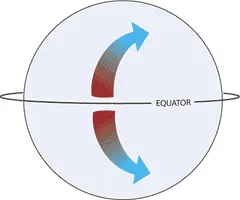
What do you think would happen if you throw a ball straight to your friend while spinning on a merry-go-round, will it go straight to them? You might think so, but actually the ball curves in your perspective and that introduces us to the coriolis force which happens on earth as well but just on a larger scale. And it’s more impactful than you’d think, it does everything from making hurricanes spin to making ocean currents swirl.
What is it?
The Coriolis force occurs because Earth is spinning on its axis that runs through the poles, and at different vertical distances(latitudes) from the equator, you travel at different speeds. If this doesn’t make sense, think about standing on the north pole, you are on the axis of rotation, so over the course of a day, you stay at the same point. But on the other hand, at the equator, you move a lot because you have travel in a large circle to get back to the same point (shown in the diagram below):
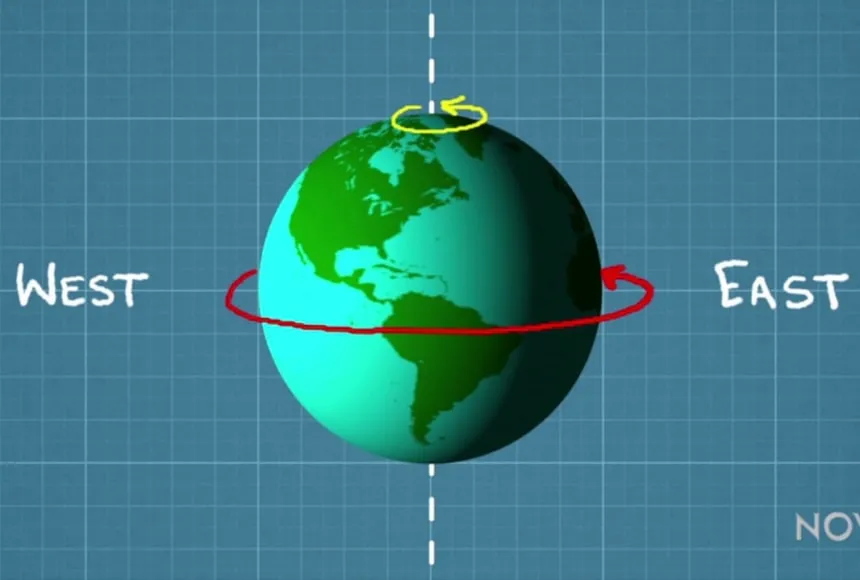
All of earth must return to the same point every 24 hours because that’s what a day is, one complete rotation of the earth; however, points nearer to the equator have to travel along a larger circle meaning they must also travel faster to “catch up”. Since we move with earth, this means someone on the equator moves faster in this frame of reference as compared to someone closer to the poles like in canada.
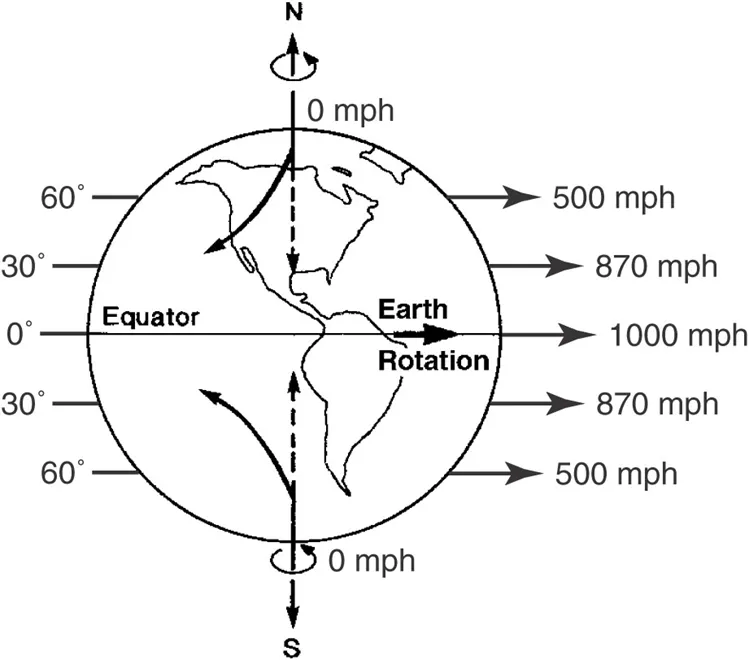
Because of this if you start at the equator and go poleward, you are moving faster relative to the new part of earth below you, so you are seemingly deflected to the east as the earth rotates from west to east. This is not an actual force deflecting you east, but we can treat it as such and often do to make our lives easier since we live on Earth; this is why we give it the name fictitious force. Likewise, if you start at the poles and move equatorward, you are moving relatively slower and are left behind-causing a seemingly deflection to the west as seen in the diagram below:
These forces affect tons of things and are essential to keep in mind throughout studying earth science. So next time when you see a hurricane, you’ll know it’s not a magical spinning top of air but instead the Coriolis force in action.